
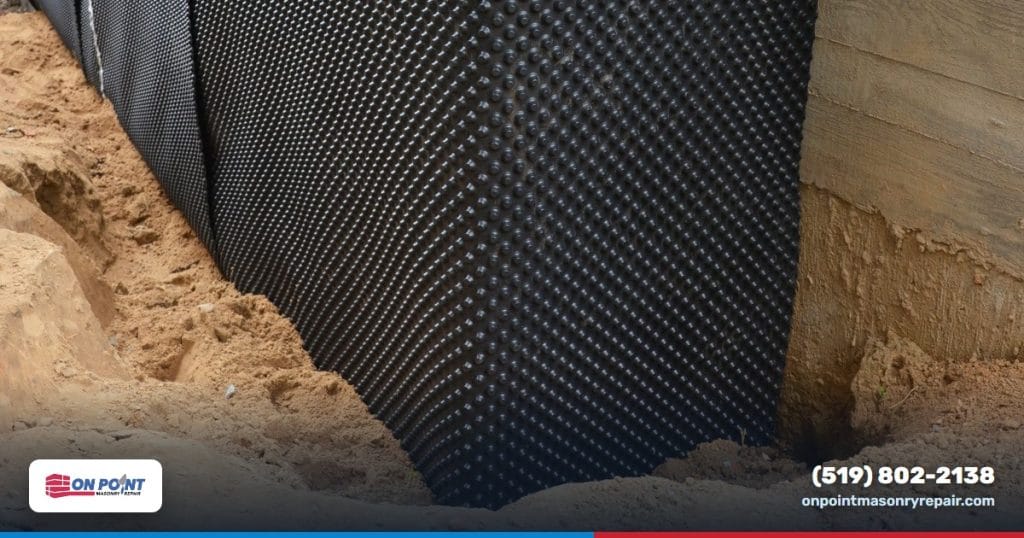
Weeping tile is the most important part of your house that you will never see. It sits in the dirt at the bottom of your foundation, it has no moving parts, and when it works you have no idea it exists. When it stops working, you find out the expensive way — usually with water along the bottom of a basement wall after a hard rain.
Here is what it actually is, how to tell whether yours has quit, and what replacing it really costs in Ontario — including the cheaper things worth ruling out first.
Last updated:
What is weeping tile, and how does it work?
Weeping tile is a perforated pipe that runs around the outside of your foundation at footing level — the very bottom of the concrete, below your basement floor. Groundwater in the soil finds the holes, drains into the pipe, and the pipe carries it away before it can build up against your wall and push its way inside.
The name is a leftover. The original systems used short lengths of unglazed clay pipe laid end to end with small gaps between them, and water "wept" in through those gaps. Nobody has used clay in decades, but the name stuck. If your house went up before roughly the 1960s and the drainage was never touched, there is a fair chance clay tile is still down there.
Modern weeping tile is corrugated black plastic pipe with slots in it, usually four inches across. Around here most people call it Big O, which is a brand name that took over the way Kleenex did. You will also hear it called drain tile, foundation drainage, or a perimeter drain. Same thing.
Some pipe comes wrapped in a fabric sock to keep silt out. It works, but in fine or silty soil the sock itself can eventually blind over and choke the pipe. Unsocked pipe in clean washed stone is often the better call in the wrong soil — which is a judgment call, not a rule.
Does your house have weeping tile?
Most houses in southwestern Ontario with a full basement have weeping tile of some kind. It has been required by building code for a long time. Older homes, cottages, additions and houses built on rock or sand sometimes have none at all, or have it on only part of the perimeter.
You usually cannot see it, but there are two decent tells from inside. If you have a sump pit, look at the pipes entering it — those are almost always weeping tile lines coming in. And in some older basements there is a small clean-out or an open pipe stub near the floor, which is an access point into the drainage. If you have neither and your basement has never been wet, that is not a problem to go looking for.
Where does weeping tile drain?
One of two places. Either it runs by gravity to daylight (a spot lower than the footing where it can just let go, which only works on a sloped lot), or it runs to a sump pit inside, where a sump pump lifts the water and discharges it outside.
In a lot of older Ontario homes the weeping tile was tied directly into the sanitary or storm sewer. Many municipalities have since moved away from that and some run programs to disconnect it, because in a heavy storm that connection can work backwards and put sewer water in your basement. If your drainage is tied to the sewer, it is worth calling your municipality and asking what their current position is — some of them help with the cost of separating it.
Weeping tile vs. French drain: what's the difference?
People use the terms interchangeably and it causes confusion when you are reading quotes. They are built the same way, perforated pipe in washed stone, but they do different jobs.
Weeping tile is a foundation drain. It sits at footing depth, tight to the wall, and its job is relieving water pressure against your foundation. A French drain is usually a yard drain, laid shallow wherever water collects, to move surface water somewhere else. A French drain in the middle of a soggy lawn does nothing for a wet basement, and weeping tile does nothing for a puddle by the shed. If a quote says "French drain," ask exactly where it is going and how deep.
We install both. Our page on weeping tile replacement and French drain installation covers when each one is the right call.
Why weeping tile fails: the four usual causes
Weeping tile does not really wear out. It gets blocked, crushed or disconnected.
| Failure | What is happening | Typical of |
|---|---|---|
| Silting up | Fine soil works through the holes and fills the pipe from the inside | Silty or clay soil, no stone, no sock |
| Root intrusion | Tree roots find the water, get in through the slots and fill the pipe | Mature trees within about 20 feet |
| Crushed or separated | Backfill, equipment or settling flattens the pipe or pulls joints apart | Poor backfill practice; old clay tile |
| Iron ochre | Naturally occurring iron bacteria form a rust-coloured sludge that plugs the pipe and the stone around it | Certain soils; more common than people expect in parts of Ontario |
Iron ochre is the frustrating one. It is a slimy orange-brown gel with a distinct smell, it comes back after cleaning, and no drainage system is permanently immune to it. If you have it, the honest conversation is about managing it with accessible clean-outs and periodic flushing, not about a permanent cure.
How do you know if your weeping tile has failed?
Failed weeping tile has a signature, and it is different from a leaking crack. A crack gives you a wet streak running down one spot on the wall. Failed drainage gives you water at the bottom.
- Water along the floor-wall joint, in more than one place, rather than one defined streak. Pressure is pushing it up underneath.
- It shows up hours after the rain stops, not during. That lag is groundwater rising, not surface water pouring in.
- Efflorescence low on the wall (the white chalky powder), concentrated near the floor.
- A sump pump that barely runs during a storm when it used to cycle. If water is not reaching the pit, something upstream is blocked.
- Standing water in the sump pit that never drains down, or a pit that stays bone dry through a wet spring.
- Soggy ground hard against the foundation long after everything else has dried out.
None of these is proof on its own. Water at the cove joint can also come from a cracked slab or a plumbing leak, which is why the diagnosis matters more than the guess. We walk through all of it in the seven causes of a wet basement.
The way to actually know is a camera. A drainage contractor can run a scope down through a clean-out and see whether the pipe is full of silt, crushed flat, root-bound or simply fine. It is not free, but it is a great deal cheaper than excavating on a hunch.
How long does weeping tile last?
Modern plastic pipe, installed in clean washed stone with a decent filter, commonly goes 30 to 50 years or more. The pipe itself does not rot. What ends its life is what gets into it or lands on it.
Clay tile is a different story. If your house is old enough to have it, it is well past its design life, and the joints that were meant to let water in are now letting silt and roots in too. Plenty of it is still limping along. Plenty has quietly stopped working.
Interior vs. exterior weeping tile replacement
You have two real options and they solve the problem from opposite directions.
Exterior replacement means excavating down to the footing, taking out the old pipe, cleaning the wall, and rebuilding the whole assembly — waterproofing membrane on the wall, dimple board, new pipe, clean stone, filter fabric. It fixes the wall and the drainage at the same time and it is the only approach that stops water before it reaches the concrete. It is also the disruptive one: your landscaping, walkways, deck and anything else against the house are in the way.
Interior weeping tile means breaking out a strip of basement floor around the perimeter, laying new pipe inside the footing, and routing it to a sump. Nothing outside gets touched. It manages the water rather than keeping it out — water still reaches the wall, it just gets collected and pumped away before it reaches your floor. It is usually the cheaper option, it works in winter, and it is often the only practical choice when the outside is inaccessible.
Neither is automatically right. If the wall itself is cracked or the brickwork above is taking on water, exterior work solves more at once. If the wall is sound and you just need the water managed, interior is usually the sensible spend. Anyone who quotes one without looking at the other has not really looked.
We do both kinds of weeping tile replacement, so you get the straight comparison rather than whichever one a contractor happens to sell.
How much does weeping tile replacement cost in Ontario?
Weeping tile is priced by the linear foot, and the honest answer is that the spread is wide because the conditions vary enormously. These are the ranges we see quoted around southwestern Ontario, not our prices — ours come as a free written itemized quote after we have actually seen the house.
| Work | Typical Ontario range | Notes |
|---|---|---|
| Camera inspection of existing drainage | Roughly $300–$700 | Needs an access point; often credited against the work |
| Flushing or snaking a partly blocked line | Roughly $500–$1,500 | Buys time; does nothing for a crushed pipe |
| Interior weeping tile | Roughly $100–$200 per linear foot | Includes breaking and repouring the floor edge |
| Exterior replacement with membrane | Roughly $250–$450 per linear foot | Deeper wall, tight access and restoration push this up |
| Sump pit and pump added or relocated | Roughly $1,500–$4,000 | More with battery backup |
The number that surprises people is the multiplier. Most houses are 140 to 200 linear feet around, so a genuine full-perimeter exterior job is a very large project. The good news is that full perimeter is often not what you need — a great many jobs are one wall, or two, where the water is actually coming in. A contractor who prices the whole perimeter without establishing that the whole perimeter has failed is selling, not diagnosing.
For how this fits with everything else in the waterproofing budget, see what basement waterproofing costs in Ontario.
Check these before you dig
We would rather tell you this before you spend money than after. A surprising number of "failed weeping tile" calls turn out to be surface water that never needed to reach the foundation in the first place.
- Downspouts. Get them discharging at least six feet from the wall. Dumping roof water at the foundation will overwhelm perfectly good drainage.
- Grading. The ground should fall away from the house. Settled backfill that has formed a trench along the wall is doing the opposite.
- Window wells. A well with no working drain becomes a bucket. Water goes over the sill, and it has nothing to do with your weeping tile.
- The sump pump itself. Pour a bucket in and watch it. If the float is stuck or the discharge is frozen or blocked, the drainage may be fine and the pump is the problem.
- Obvious cracks. A wet streak from a single crack is a crack injection job, usually one visit, and nothing to do with drainage.
If you have done all five and the water is still coming up along the floor after every heavy rain, then the drainage is a real suspect and it is worth putting a camera down there.
Common questions
What is the purpose of a weeping tile?
To relieve water pressure against your foundation. It is a perforated pipe at footing level that collects groundwater from the soil and carries it away to a sump or a gravity outlet, so the water never builds up against the wall and gets pushed through the concrete.
How do I tell if I have weeping tile?
Look at your sump pit. The pipes entering it are almost always weeping tile lines. Some older basements also have a small clean-out or open pipe stub near the floor that gives access to the drainage. If you have neither, a camera inspection through an access point is the only way to know for certain without digging.
Do all homes have weeping tiles?
No. Most southwestern Ontario homes with a full basement do, because it has been required by code for a long time, but older houses, cottages and additions sometimes have none at all or have it on only part of the perimeter.
Is weeping tile the same as a French drain?
They are built the same way but they do different jobs. Weeping tile is a foundation drain at footing depth that relieves pressure against your basement wall. A French drain is usually a shallow yard drain that moves surface water away from a wet area of the property. One will not do the other's job.
How long do weeping tiles last?
Modern perforated plastic pipe in clean washed stone commonly lasts 30 to 50 years or more. The pipe does not rot; what ends its life is silt, roots, crushing or iron ochre. Old clay tile systems are well past their design life and many have quietly stopped working.
What happens when a weeping tile fails?
Groundwater stops draining away and builds up against the foundation instead. You typically get water appearing along the floor-wall joint in more than one spot, often hours after the rain has stopped, along with efflorescence low on the wall and a sump pit that behaves oddly.
Do weeping tiles need to be replaced?
Only if they have actually failed. A partly silted line can sometimes be flushed and kept working for years. A crushed, collapsed or root-filled pipe cannot be cleaned and has to be replaced. A camera inspection is what tells you which situation you are in.
How much does it cost to replace weeping tile?
In Ontario, interior weeping tile is commonly quoted around $100 to $200 per linear foot, and exterior replacement with membrane around $250 to $450 per linear foot. Most houses are 140 to 200 feet around, but many jobs only involve the one or two walls where water is actually getting in.
Is weeping tile covered by insurance?
Replacing failed drainage is normally treated as maintenance and is not covered. Resulting water damage sometimes is, depending on your policy and whether you carry a water or sewer backup endorsement. Coverage varies a lot between insurers, so read your own policy or ask your broker directly.
Do you put gravel under weeping tile?
Yes. The pipe is bedded in and covered with clean washed stone, usually with filter fabric over the top, so water can move freely to the pipe and fine soil is kept out. Pipe laid straight into soil silts up quickly, which is one of the most common reasons older systems fail early.
Not sure whether your drainage has actually failed?
That is worth establishing before anyone starts digging, because the difference between a blocked line and a crushed one is the difference between a flush and a full excavation. We will come look, tell you honestly what we think is going on, and give you a free written itemized quote — including telling you if the fix is a downspout extension and not us.
Call (519) 802-2138Free written assessments across Paris, Brantford, Brant County, Cambridge, Woodstock, Guelph, Simcoe, Kitchener, Waterloo and Hamilton.
More on the systems this connects to: basement and foundation waterproofing, and basement leak repair when you already know where the water is coming in.