
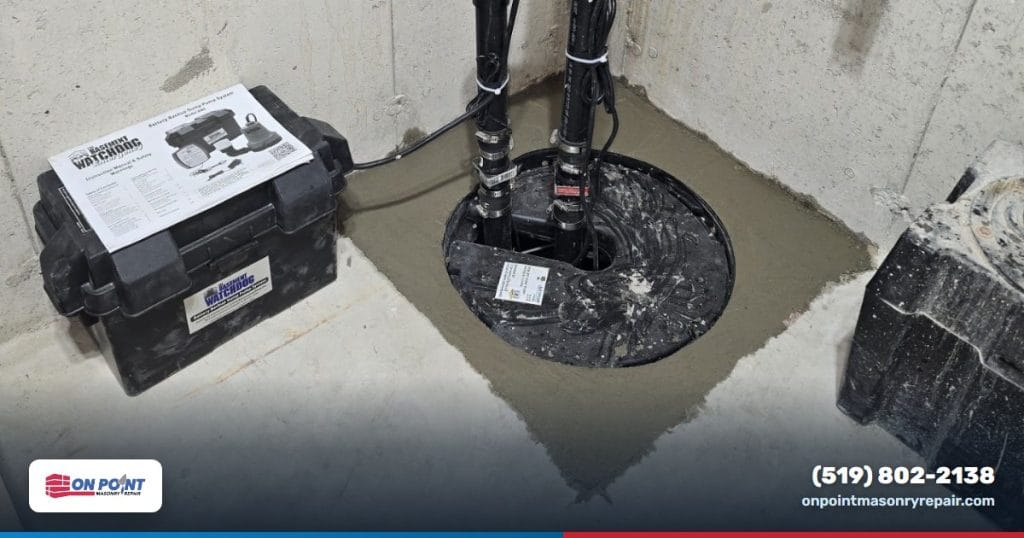
Sump pump pricing is confusingly spread out: the pump itself might be $150 at the hardware store, yet installation quotes can run from a few hundred dollars to several thousand. Both numbers are real — they're just describing different jobs. Here's how the pricing actually works in our corner of Ontario, from a crew that installs and replaces these across Paris, Brantford, Kitchener-Waterloo and the surrounding area.
Last updated:
Sump pump installation cost in Ontario: the three tiers
1. Straight replacement — the affordable one
Your pit, basin and discharge line already exist; the pump itself is tired or dead. Swapping in a quality new submersible, checking the float switch and check valve, and testing under load is typically in the $500–$1,200 range all-in, depending on the pump you choose. If your pump is 7–10 years old, this is the maintenance move that beats a flooded basement — pumps rarely announce their retirement in advance.
Sometimes the pump isn't dead at all. A stuck float switch or a failed check valve is a sump pump repair, and that's the cheaper fix.
2. New installation — pit and all
No sump at all? Then the job includes breaking the slab, setting a proper basin, concrete work, the pump, the check valve and a discharge line that carries water well away from the foundation. Typical range: $1,500–$3,500+, driven mostly by concrete access and how far the discharge has to run. Plenty of older homes around Paris and Brantford were built without one — the first wet spring usually makes the case.
3. Battery backup — the insurance policy
Adding a battery backup system typically runs $1,000–$2,500 including the backup pump, battery and controller. Whether it's worth it comes down to one question: what's in your basement? If the answer is "a finished rec room" or "everything we own," remember that the storms most likely to flood your basement are the same ones that knock the power out. A primary pump with no power is a bucket.
These are typical market ranges for our region, not a quote — your house sets the real number, which is why our quotes are free, written and itemized.
What changes the price of a sump pump installation?
- Pump quality. A contractor-grade cast-iron submersible costs more than a big-box special and outlives it several times over. This is not the place to save $100.
- Discharge routing. Water needs to exit at least six feet from the wall, ideally onto grade that slopes away. Long or awkward runs add labour.
- Slab and access. Thick concrete, tight mechanical rooms and finished basements all slow the pit work.
- Drainage tie-ins. If the sump is part of a bigger fix, say an interior waterproofing system feeding it, the pump is one line on a larger scope.
Frequently asked questions
How much does sump pump installation cost in Ontario?
Plan on $500 to $1,200 all-in to replace a pump in an existing pit, $1,500 to $3,500 or more for a brand-new pit, basin and discharge line, and $1,000 to $2,500 to add a battery backup. Those are typical southwestern Ontario ranges; your house sets the real number, so get a written, itemized quote.
How long does a sump pump last?
Plan on 7–10 years for a typical submersible — less if it cycles constantly. New noises, short-cycling or a pit that stays full are the warning signs worth acting on, and a little sump pump maintenance twice a year helps it reach the long end of that range.
Can I install a sump pump myself?
A handy homeowner can swap a pump in an existing pit. A new installation means breaking concrete, setting the basin at the right depth relative to the footing, and routing discharge properly — get that depth or routing wrong and the system runs constantly or doesn't protect the slab at all. That one's worth hiring out.
Why is my sump pump running all the time?
Common causes: a stuck or badly set float switch, a failed check valve letting pumped water drain straight back, a pit that's too small, or genuinely high groundwater. Constant running cooks the motor — worth a look before it becomes a replacement.
Does a sump pump stop basement leaks?
It handles water that reaches the pit. Water coming through wall cracks needs crack repair, and ongoing seepage may need drainage or waterproofing. The right answer is often a combination — which is why it helps that we do all of it.
Want a real number for your basement instead of a range?
We'll come take a look, free, and tell you whether you need a new pump, a repair or nothing at all. Every quote is written and itemized, so you know exactly what you're paying for.
Call (519) 802-2138Free assessments across Paris, Brantford, Brant County, Cambridge, Kitchener, Waterloo, Guelph, Hamilton, Woodstock and Simcoe — or read more about our sump pump installation service.