
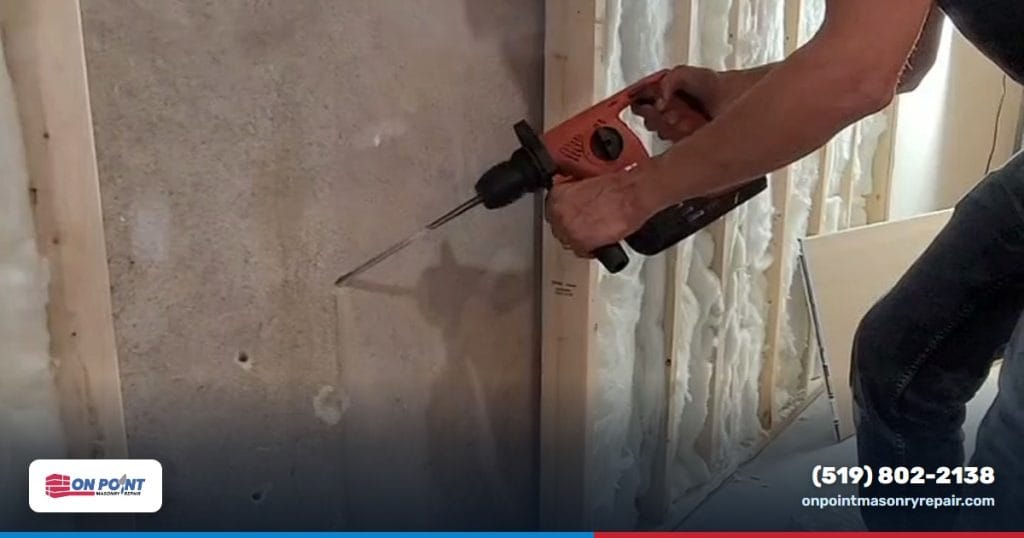
Finding a crack in your foundation is the kind of thing that ruins a Saturday. Before it ruins your month too: most foundation cracks are not structural, and the ones that are usually announce themselves in ways you can learn to read in about five minutes. Here's how we sort them on real jobs across Paris, Brantford and southwestern Ontario, what the repair actually costs here, and the honest part — the number depends far more on which crack you have than on who you hire.
Last updated:
How do you know if a foundation crack is serious?
Direction tells you most of what you need to know. A crack's orientation is a fingerprint of the force that made it, and three shapes cover nearly everything we get called out to look at.
Usually fine
Vertical, hairline to 1/8"
The most common crack in a poured wall, and normally a shrinkage crack from the concrete curing in its first couple of years. Same width top to bottom, no displacement.
Seal it if it leaks. Otherwise watch it.
Worth watching
Diagonal, or stair-step in block
Usually one part of the footing settling more than another. On its own it often isn't serious. Alongside doors that stick, sloping floors or new gaps at the trim, it means something is still moving.
Get eyes on it, especially if it's growing.
Call someone
Horizontal, any width
The one that matters. A horizontal crack means soil pressure is pushing the wall inward rather than the wall simply shrinking, and a wall that bends keeps bending.
Don't seal it and hope. Have it assessed.
Two other things are worth measuring rather than guessing at. Start paying attention past about 1/8 of an inch, and get a professional opinion past 1/4 inch, if one side sits proud of the other, or if upstairs doors and windows have started sticking. Width alone isn't the whole story, but a crack that's visibly wider this year than last is telling you it's still moving.
The reassuring number: home inspection data suggests only around 15% of foundation cracks turn out to be structurally serious. The other 85% are a water problem, not a building problem — which is a much cheaper sentence than most people expect when they first spot one. This Old House has a good primer if you want a second read before calling anyone.
How much does foundation crack repair cost in Ontario?
Here's the short version, then the reasons behind it.
Those are market ranges for our region rather than a quote from us. What moves a number inside them is boringly practical: how long the crack is, whether it's leaking right now, whether your wall is poured concrete or block, and whether we can reach it without moving a finished basement out of the way. A crack behind a framed and insulated wall costs more than the same crack on bare concrete, because someone has to open it up and put it back. Ours are free, written and itemized before anything starts.
Worth saying plainly, because the internet is full of horror stories: a leaking crack is one of the least expensive foundation repairs there is. The eye-watering numbers you read about are for underpinning, wall replacement and full excavation — different problems entirely. We break the wider picture down in our Ontario basement waterproofing cost guide.
What is crack injection? Epoxy vs. polyurethane
Injection isn't filling a crack the way you'd caulk a gap. We drill a line of small ports along the crack, seal the face so nothing escapes, then pump resin in under pressure until it travels the full thickness of the wall and comes out the far side. That's the whole point. A surface patch stops water where you can see it and lets it keep travelling inside the concrete; injection fills the crack front to back so there's no path left.
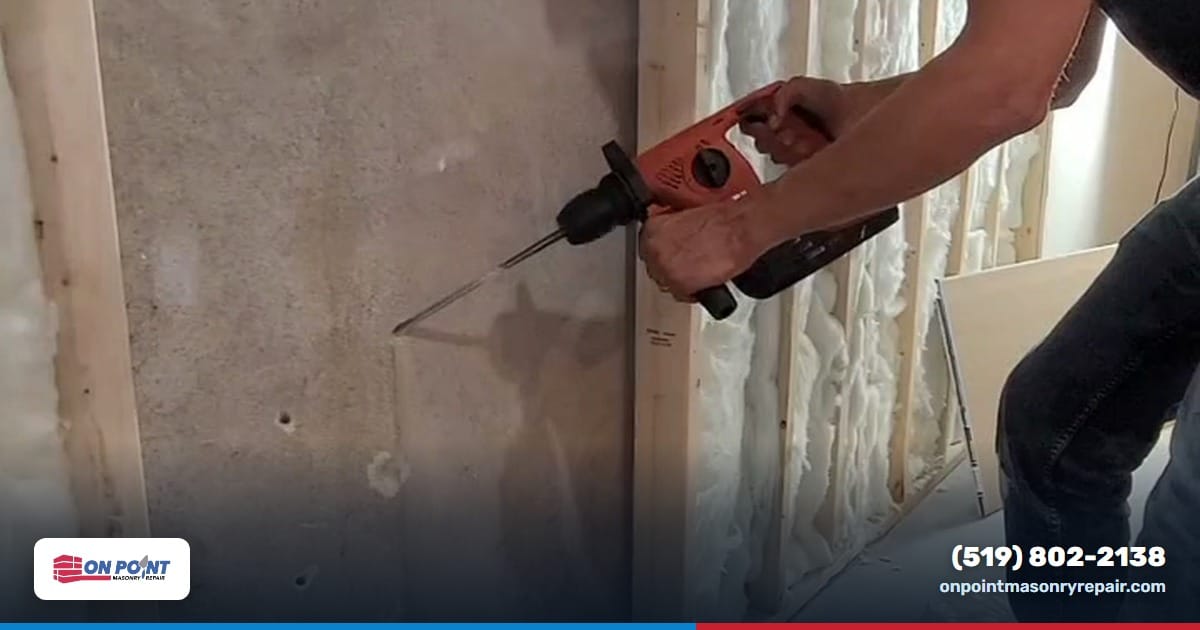
There are two resins, and contractors are sometimes vague about which one they're using. They do genuinely different jobs.
- Polyurethane is a flexible foam that reacts with moisture and expands as it cures. It seals an actively leaking crack, and it tolerates a crack that still moves a little with the seasons. For a wet basement, this is usually the right answer.
- Epoxy is rigid and doesn't expand, and cured epoxy is stronger than the concrete around it. It effectively welds the two sides back together, which matters when the crack is a structural concern. It wants a relatively dry crack to bond properly.
Put simply: polyurethane seals, epoxy welds. Water problem, poly. Structural problem, epoxy — and sometimes both, on the same wall, for different reasons. If you want the technical version, SealBoss publishes a straight comparison. Anyone quoting you injection should be able to say which they're using and why without hesitating.
Is it better to repair foundation cracks from inside or outside?
Inside, for most leaking cracks in a poured wall. It's a single visit, no machine, no torn-up garden, and it costs a fraction of digging. When injection is the right repair, it isn't the budget option — it's the correct one.
Outside earns its money when the crack isn't really the problem. If the wall is concrete block, if the exterior membrane has failed along its whole length, if several cracks are leaking at once, or if water is coming through the floor-wall joint as well, then you're not fixing a crack any more — you're fixing drainage. That's exterior waterproofing, and no amount of resin substitutes for it. The same goes if the crack is buried behind finished space we can't reach from inside.
The honest test is what a contractor does before quoting. Anyone who recommends excavation without first looking at where the water actually enters is selling the expensive option by default. If your basement is wet in more places than the crack, read how to fix a leak in a basement wall first — the source matters more than the fix.
When a crack needs more than injection
This is the part product pages skip. Injection is a waterproofing repair. It has very little structural strength, and it will not stop a wall that is bowing inward — sealing a horizontal crack and calling it done is how a small problem becomes a rebuild.
Where a wall is moving, the usual approach is carbon fibre straps bonded across the wall to stop further movement, often paired with injection so the crack stops leaking at the same time. One holds it still, the other keeps it dry. Carbon fibre works on poured concrete walls bowing less than roughly two inches; past that, or on block walls with real displacement, the conversation moves to steel and to an engineer. That's a bigger job than we'd quote off a photo, and if that's your wall we'll tell you so rather than sell you a resin repair that can't do the work.
For the wider picture, from crack injection to block and stone wall repair, see our foundation repair page. We'll tell you plainly when a wall needs an engineer instead of us.
Can I fix a foundation crack myself?
A dry hairline crack above grade? Sure — clean it out and run a quality masonry caulk into it, and keep an eye on whether it grows. That's a reasonable weekend job.
A leaking crack is a different thing. The DIY move most people make is packing it with hydraulic cement, which plugs the inside face and leaves the water sitting in the wall, so it reappears a foot away next spring. Homeowner injection kits do exist and they can work, but the failure modes are unforgiving: too little pressure and the resin never reaches the back of the wall, too much and it blows the surface seal off. You get one attempt, because a crack full of failed resin is harder to inject properly afterward.
And a horizontal crack is not a DIY project under any circumstances. That's not us protecting our trade — it's that sealing it hides the only symptom you had.
Frequently asked questions
How much does it cost to repair a cracked foundation?
In Ontario, a single leaking crack injected from inside typically runs $500 to $1,500, and that covers most cracks in a poured concrete wall. Excavating a problem wall from outside runs into several thousand and up, because you're paying for a machine, a trench and putting the yard back. Length, access and whether the crack is actively leaking are what move the number.
How do you know if a foundation crack is serious?
Look at direction first. Vertical hairline cracks of even width are usually shrinkage and rarely structural. Diagonal and stair-step cracks point to settlement and are worth watching. A horizontal crack means soil pressure is pushing the wall in and should be assessed by someone regardless of how narrow it looks. Past a quarter inch, with one side sitting proud of the other, or with upstairs doors sticking, get an opinion.
What is crack injection?
Ports are drilled along the crack, the face is sealed, and resin is pumped in under pressure until it fills the crack through the full thickness of the wall. Polyurethane is a flexible foam that seals active leaks and tolerates slight movement. Epoxy is rigid and stronger than the surrounding concrete, so it's used where the crack is a structural concern rather than just a wet one.
Is foundation crack repair worth it?
For a leaking crack, yes, and it's one of the cheapest foundation repairs there is. Water in a wall doesn't stay put — it wrecks finishes, feeds mould and gets worse every winter, and an unresolved water issue costs far more in a home sale negotiation than the repair would have. For a dry hairline crack that hasn't changed in years, the honest answer is that you can leave it alone and keep an eye on it.
What is the best time of year for foundation crack repair?
Any time of year, for interior injection. It's done from inside a heated basement, so winter works fine, and a crack that's actively leaking in spring is the easiest one to find. Exterior excavation is easiest from spring to late fall, before the ground freezes.
Send us a photo before you worry about it
Most of the cracks people send us turn out to be the cheap kind. We'll tell you which sort you've got, what it needs, and whether it needs anything at all — and if it's the serious kind, we'll say that plainly too rather than sealing it and moving on.
Call (519) 802-2138Free written assessments across Paris, Brantford, Brant County, Cambridge, Kitchener, Waterloo, Guelph, Hamilton, Woodstock and Simcoe — or read more about our foundation crack repair service.