
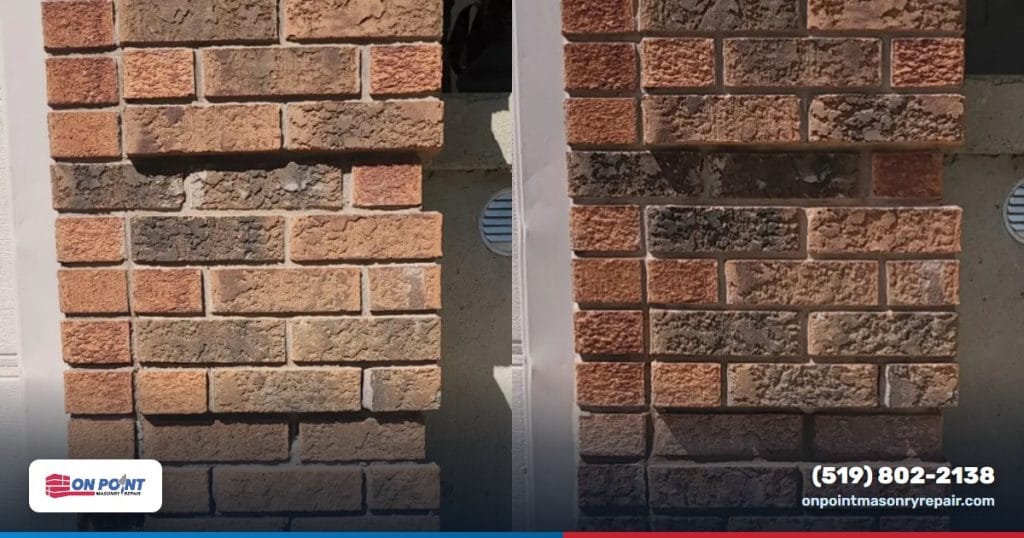
The short answer
Efflorescence is salt, not mould. Water moving through brick, block or concrete dissolves minerals inside it, then evaporates at the surface and leaves them behind as a white, chalky powder. It's harmless to you and usually to the wall. What matters is the water: if it keeps coming back, find where the water is getting in.
Sooner or later most Ontario homeowners notice it: a white, chalky crust low on the basement wall, or a pale haze spreading across the brick under a window. It brushes off, it comes back, and nobody seems sure whether it matters.
It does and it doesn't. Here's what efflorescence actually is, a simple test that tells it apart from mould, when it's only cosmetic, and when it's the first sign of a leak or a masonry repair you'd rather catch early.
Last updated:
What efflorescence actually is
Efflorescence is mineral salt that water has carried out of a wall. Concrete, mortar, brick and the soil against your foundation all hold salts that dissolve in water. When that water works its way to the surface and evaporates, the salt stays behind as a white powder or crust.
The Brick Industry Association's technical note on efflorescence boils it down to three conditions that have to exist at the same time: soluble salts, enough water to dissolve them, and a path for that water to reach the surface. Take away any one of the three and it stops.
It also tends to be worst in winter and early spring. The same BIA note says efflorescence that appears more than a year after construction can generally be traced to too much water getting in or to poor drainage, and that it's often most severe in cold weather.
Basement walls vs. exterior brick: what the spot tells you
On a basement wall, the water is coming from the soil outside. On exterior brick, it's usually rain from above or moisture soaking up from the ground. Where the white appears tells you more than how much of it there is.
| Where you see it | What it usually points to | Check first |
|---|---|---|
| Low on a basement wall, near the floor | Groundwater pressing on the foundation | The weeping tile and the sump |
| In a line along a crack | Water coming through the crack | The crack itself, which usually takes crack injection |
| A band near the top of a basement wall | Surface water soaking in at ground level | Downspouts, grading and window wells |
| On the basement floor | Moisture coming up through the slab | Drainage under and around the floor |
| Under a window sill outside | Water getting into the brick at the sill | The sill and the joints around it |
| High on a chimney | Water getting in from the top | The chimney crown, cap and flashing |
| Low on exterior brick | Splash-back and ground moisture wicking up | Eavestroughs, downspouts and soil piled against the wall |
| All over a wall in its first year | "New building bloom" from construction moisture | Usually nothing; it weathers off |
That last row is the good news, because the BIA says new building bloom will, in most cases, dissipate over time once the wall dries out and wind and rain have a chance to clean it. On an older house, the water is coming from somewhere, and it's worth finding.
Efflorescence vs. mould: a simple test
It's the first thing most people worry about, and it's easy to settle. InterNACHI's guide for home inspectors lists the tells, and you can check them in a minute with a spray bottle and a pair of gloves.
- Spray it with water. Efflorescence dissolves and soaks in, while mould just sits there.
- Pinch some between gloved fingers. Efflorescence crumbles to powder, while mould smears or feels fuzzy.
- Look at what it's growing on. Efflorescence forms on concrete, block, brick, stone and mortar. Mould needs something organic, like drywall paper, wood, cardboard or dust.
- Check the colour. Efflorescence is almost always white, yellow or brown. Mould can be almost any colour, and it usually smells musty.
The catch is that both can turn up in the same basement, salt on the bare concrete and mould on the framing beside it, because both run on the same water. If you do find mould, Health Canada's guide to moisture and mould says up to three small patches totalling less than 1 square metre can be cleaned with unscented soap and water. Skip the bleach, and fix the moisture, or the mould comes back.
Is efflorescence harmful?
Not to you: it's mineral salt, nothing living, and it doesn't release spores. InterNACHI notes that efflorescence alone doesn't pose a major problem, though the damp behind it can encourage mould.
The wall is usually fine too, as long as the salt forms on the surface, and the BIA calls efflorescence "usually not harmful to brick masonry." The trouble starts when salt crystallizes just under the surface instead, which the U.S. National Park Service's guide to repointing says creates enough pressure to make the outer face of a brick or stone spall off.
When it's a moisture problem worth fixing
Treat efflorescence as a leak indicator, not a cleaning job, when any of these are true:
- It comes back within weeks of cleaning, or keeps spreading.
- It runs along a crack or along the joint where the wall meets the floor.
- There are dark damp patches, a musty smell, or water on the floor after heavy rain.
- Paint on the concrete is bubbling or flaking, with white powder underneath.
- The brick or stone faces around it are flaking or crumbling.
Start with the cheap fixes outside, because sometimes they're all it takes. The Intact Centre on Climate Adaptation recommends extending downspouts and grading the soil so water ends up at least 2 metres from the foundation. Clear the window wells too, then watch the wall through the next wet season.
If it's still coming back, the fix depends on where the water gets in. A leaking crack is usually a single visit of crack injection. Water at the base of the wall needs drainage, either interior waterproofing that collects it and routes it to a sump, or exterior waterproofing that stops it before it reaches the wall.
Our basement leak repair work starts by finding which one you've got, and the seven causes of a wet basement is a good primer.
What not to do is paint or seal over it and call it fixed. A waterproofing paint on a wall that's still moving water traps the moisture and salt in the concrete, and the coating blisters and peels as the salt pushes through. On exterior brick it's worse, because the BIA warns that a coating which stops water evaporating can trap salts inside the masonry, where they crystallize and can spall the brick.
When it's cosmetic, and how to clean it
Efflorescence is genuinely just cosmetic in three cases: new building bloom on a wall under a year old, a one-time bloom after an unusually wet season, or a light dusting that stays the same year after year with no damp. In those cases, clean it and keep an eye on it.
- Wait for the wall to dry. Brushing a damp wall just smears the salt around.
- Dry-brush it first. A stiff nylon brush takes off most of it, and the BIA says dry brushing usually does the job. Vacuum up the dust, and skip wire brushes, which can leave steel bits that rust-stain the surface.
- Use diluted white vinegar on stubborn spots on concrete. Scrub, wipe with a damp cloth and let it dry. Test a hidden patch first, and keep acids, even mild ones, off soft old lime mortar and limestone.
- Skip the pressure washer and the muriatic acid. InterNACHI warns that washing with water can let the salt crystals soak back into the wall. Strong acid can etch concrete and mortar and stain some brick.
If it's back within a few weeks, cleaning was never the fix, so go back to the table above and find the water.
The masonry side: spalling and mortar
On brick and stone, the white powder is the least of it. What matters is how much water the wall is taking on, because water that keeps soaking into masonry does two kinds of damage.
The first is spalling, where the face of a brick or stone pops off. Salt crystallizing just under the surface is one cause, and water that soaks into brick and then freezes is the other, because it expands and pries the face loose a little more each winter.
The second is mortar. Joints are meant to be the softer, more breathable part of the wall, so water and salt leave through them instead of through the brick. The same NPS guide is blunt about it: repointing mortar has to be softer and more vapour permeable than the brick or stone, and the guide shows hard cement mortar on soft old brick causing exactly this kind of spalling.
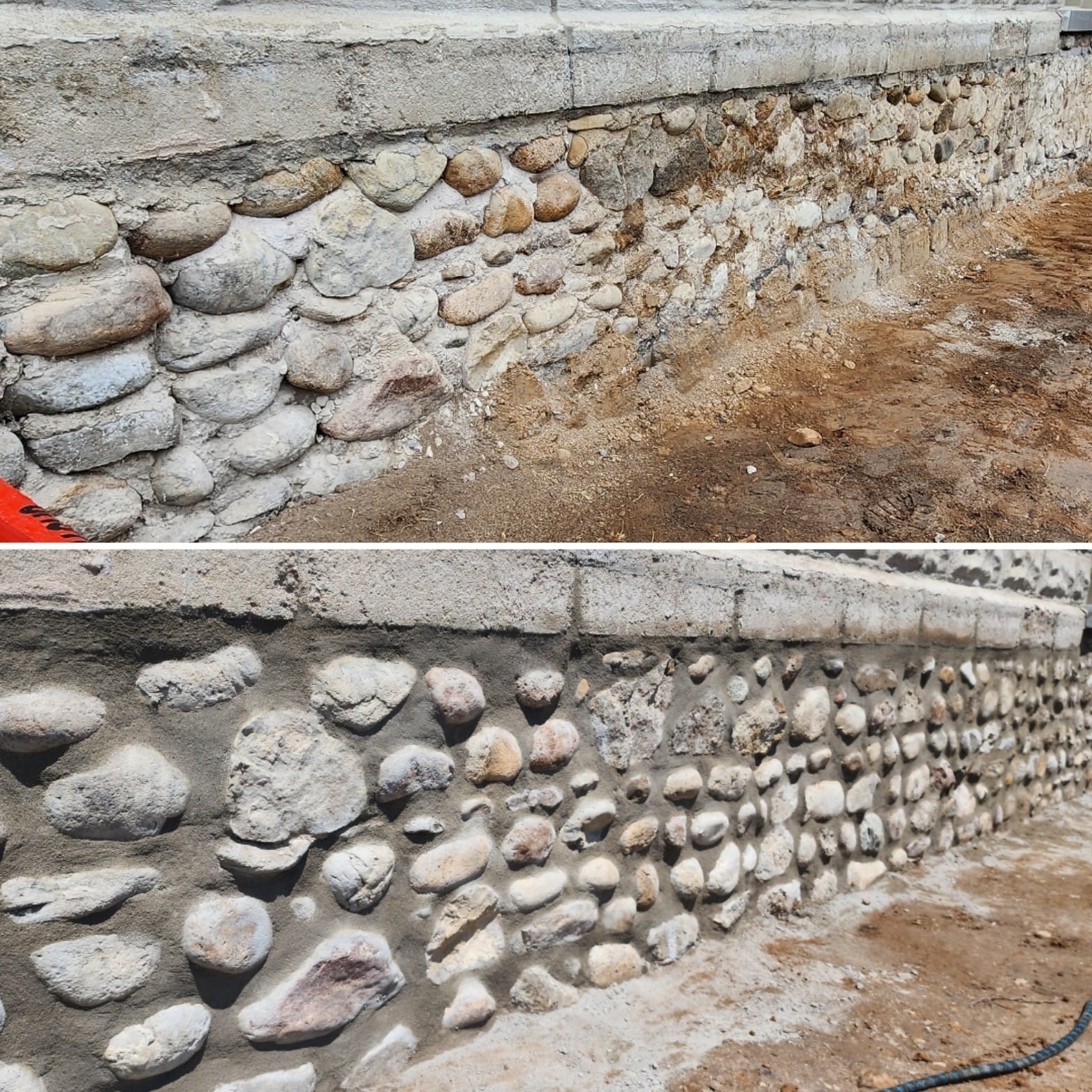
So if the white is on your brick or a stone foundation and the faces are flaking or the joints have gone sandy, it's time for masonry repair and probably repointing with a mortar matched to the wall. For the fieldstone and cobblestone foundations around Paris and Brant County, see our stone foundation repair and heritage stone restoration pages.
Common questions
Should I worry about efflorescence?
Not about the powder, but about the water behind it. A one-time dusting on a new wall is normal. Efflorescence that keeps coming back, spreads, or shows up with damp patches, peeling paint or flaking brick means water is getting in, and that's worth tracking down.
Is efflorescence harmful?
No, not to people. It's mineral salt, it isn't alive and it doesn't release spores. The risks are indirect: the damp that causes it can feed mould on nearby wood or drywall, and salt crystallizing under the surface of brick or stone can make the face spall off.
Does efflorescence mean mould?
No: efflorescence is salt and mould is a living growth, so if you spray it with water, efflorescence dissolves while mould doesn't. They can show up in the same damp basement, though, because both are caused by moisture.
Is efflorescence on basement walls bad?
It's a warning, not damage. It means water has been moving through the foundation wall, and where it shows up tells you where. Low on the wall points to groundwater and drainage, a line along a crack points to that crack, and a band near the top points to downspouts or grading.
Will efflorescence eventually go away?
On a new wall, usually yes: the Brick Industry Association says new building bloom generally dissipates as the wall dries and weathers. On an older wall, it only goes away for good when the water feeding it stops, so it comes back every wet season until the source is fixed.
How do I get rid of efflorescence?
Dry-brush it off with a stiff nylon brush once the wall is dry, and vacuum up the dust. Diluted white vinegar usually shifts stubborn patches on concrete. Avoid pressure washing and strong acids, and deal with the water, or it will be back.
Can you just paint over efflorescence?
No: paint won't bond to the salt, and as long as water is moving through the wall, the salt pushes the paint off from behind. Sealing a wall that's still wet also traps the moisture inside it. Fix the water first, clean the wall, and only then think about a coating.
What happens if you seal over efflorescence?
The water and salt get trapped behind the sealer. The salt then crystallizes inside the masonry instead of on the surface, and that pressure can blister the coating or spall the face off brick and stone. That's why the Brick Industry Association doesn't recommend coatings as the only treatment.
White powder that keeps coming back?
That's water telling you where it's getting in. We'll look at the wall inside and out, tell you straight whether it's cosmetic, a drainage problem or masonry that needs attention, and give you a free written itemized quote. If the fix is a downspout extension, we'll say so.
Call (519) 802-2138Free assessments across Paris, Brantford, Brant County, Hamilton, Cambridge, Kitchener, Waterloo, Guelph, Woodstock and Simcoe.
More on the repairs this can lead to: basement leak repair, interior basement waterproofing, masonry repair and brick repointing.