
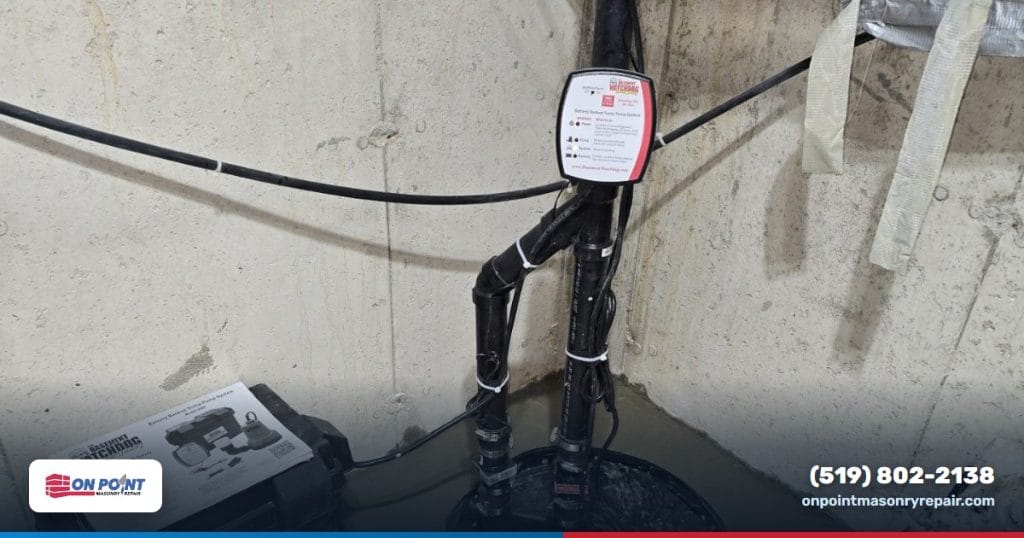
A battery backup sump pump is the easiest upsell in this trade, which is exactly why you should be suspicious of anyone who calls it mandatory. Some houses genuinely need one. Plenty don't. Here's how we work through it on real jobs across Paris, Brantford, Kitchener-Waterloo and the rest of southwestern Ontario, including the honest part: the runtime numbers on the box aren't what most people think.
Last updated:
Does your sump pump need a battery backup?
The case for one is mechanics, not fear. The weather that dumps water on saturated ground is the same weather that puts trees onto power lines. When the derecho crossed southwestern Ontario on May 21, 2022, it left more than 350,000 Hydro One customers without power, and the utility said restoring everyone would take days. On a night like that your pump was never the weak link. The outlet was.
So it earns its keep in a finished basement, under a pump that works hard every spring, or on a rural property at the end of a long line. Are you on a rural feeder? Long runs with trees on them go out more often and come back slower. The concessions around Burford and St. George aren't downtown Brantford.
And here's where we tell people to save their money instead:
- Your primary pump is nine years old. Repair or replace the pump first. Bolting a backup onto a unit that's about to quit protects the wrong thing.
- Your water comes through the walls. A sump only handles water that reaches the pit. Seepage through a crack or the floor-wall seam needs crack repair or interior drainage, and water pushing in from outside is a job for exterior waterproofing.
- The pit runs twice a spring and the basement is unfinished. Spend it on something that's actually failing.
- Your downspouts still dump beside the foundation. Six-foot extensions and a bit of grading do more for that house than $2,000 of backup system.
How does a battery backup sump pump work?
Here's the part most product pages get wrong. A backup doesn't sense that your pump has failed. It senses water.
A second float sits higher in the pit than the primary's. When water climbs past the level the main pump should have cleared, the DC pump starts, whatever the reason was. Outage, seized motor, stuck float, tripped GFCI, clogged intake, or simply more water arriving than the primary can move. Same trigger, every time.
If the primary is already eight or nine years old, a matched combination unit makes more sense than a bolt-on backup. One assembly, AC primary and DC backup, both new. And one boundary worth stating plainly: the pit, the pump and the backup unit are our work, and when a job needs a new circuit at the panel or licensed plumbing work, we bring in the trade that's licensed for it rather than working around it.
Can you add a battery backup to an existing sump pump?
Usually, yes, and that's most of what we do. What decides it is room. The pit needs space for a second pump and float without the two fouling each other, and the backup discharge has to tie in above your existing check valve so pumped water can't circle straight back into the pit. If the second float can't clear the first, we say so before you buy anything.
The battery wants dry floor space above any water line, near an outlet, reachable enough that you'll actually lift it out in four years. It weighs about as much as a bag of cement, so where it sits matters more than people expect.
Can a handy homeowner fit a kit into an existing pit? With room to spare, yes. The mistakes are specific: a float set too low drains the battery on ordinary water levels, a discharge joined below the check valve pushes water in circles, and a pump set down on silt eats itself.
One thing to know before you start, though. If a municipal grant is part of your plan, what disqualifies people is starting work first — Brantford approves the job before it begins and inspects it after. Its program was paused for updates when we checked in October 2026, so ask the City whether it has reopened and what they want to see before you buy anything or hire anyone.
How long will a battery backup last on a sump pump?
Plan on three to five hours of real pumping from a healthy 75 amp-hour AGM battery, and five to seven hours from a 100 to 120 amp-hour one. A three-year-old battery in a heavy spring event gives you hours, not days.
That's shorter than the box says, and the gap is duty cycle. Basement Watchdog's emergency backup advertises 80 hours, and its own footnote says that figure assumes the pump runs 10% of the time, so it's eight hours of pumping spread across those 80. Zoeller is the straight one. They publish six hours of continuous pumping and 48 or more at a 10% duty cycle, side by side, same battery.
The number nobody advertises is the recharge. The charger built into a common backup unit puts out 0.4 amps, which needs the better part of four days to refill a half-drained battery. Ontario storms travel in packs. The second night is the one that gets people.
Cold matters less than you'd think, as long as the basement is heated. Figure roughly 10% capacity loss for every 10°C below room temperature, so 15°C is fine and an unheated crawlspace isn't. A charged lead-acid battery won't freeze down there. A flat one freezes around −8°C and it's finished, which is why a charger that quietly quit in November is a winter problem rather than a cold-weather one.
How much does a battery backup sump pump cost in Ontario?
Adding a backup to a sound pit and pump runs $1,000 to $2,500 installed the way we do it, depending on the pump, the battery and how the discharge has to be tied in. Published Ontario ranges for a bare-bones add-on start lower, nearer $400, and that's about what a kit dropped into a roomy pit with an easy tie-in should cost. A complete new system with pit, primary, backup and discharge costs more, and we broke those numbers out in our sump pump installation cost guide. Either way, every number we give you is free, written and itemized in a quote.
Then there's the part that repeats. Plan on $250 to $400 for a replacement AGM battery every four to seven years. It's the cheapest component in the system and the one that decides whether the rest of it works.
Brantford & Brant County Basement Flooding Grants (checked October 2026)
The County of Brant, which covers Paris, pays 50% of a new sump pit and pump with battery backup, up to a $5,000 lifetime maximum per property. The City of Brantford pays 80% of the same kind of new setup, up to $4,000, but it has paused new applications while it updates the program, with changes expected by October 30, 2026.
This is the part the national cost sites can't tell you, and it moves the math more than any product choice you'll make.
| Municipality | Covers | For a new sump pit & pump with battery backup | The catch |
|---|---|---|---|
| City of Brantford paused for updates | 80% of eligible costs $5,000 property max | up to $4,000 | Not taking new applications while the City updates the program; the changes are expected by October 30, 2026. That $4,000 line is written for a new pit and pump. Adding a backup to a pump you already have isn't a listed item, so call the City before you count on it. It also won't pay for a water-powered backup on municipal water. Work has to be approved before it starts and inspected after, and your downspouts must already be disconnected. |
| County of Brant covers Paris | 50% of eligible costs $5,000 lifetime max | up to $5,000 i.e. half the bill, to that cap | Funds a new system, not an upgrade or replacement. Your property has to be connected to the County stormwater system, the sump has to discharge to ground surface, the home must predate 2012, the work has to be finished within six months of approval, and you'll need documentation of a basement flooding insurance claim or something else County staff accept. |
| City of Hamilton | grant up to $2,000 | not listed | Built around backwater valves. It covers a sump pump only when one goes in with a backwater valve, the full grant needs one of the City's pre-qualified contractors, and the home must be single-family and built before 2012. Battery backups aren't on the eligible list, so treat it as a phone call to make rather than a number to budget against. |
We checked the Brantford, County of Brant and Hamilton program pages on October 5, 2026. Cambridge, Kitchener, Waterloo, Guelph, Woodstock and Norfolk County don't currently advertise a program of their own. Funding in Brantford and the County is first-come, first-served against an available budget, councils change these programs, and the details above are the ones each municipality publishes today, so check current terms on their own page before you count on a dollar of it.
What are the alternatives to a battery backup sump pump?
- A water-powered backup. No battery, nothing to charge, runs as long as city pressure holds. That's also the catch. It needs municipal water, so it's out for anyone on a well, and close to half of County of Brant residents are. It generally needs an RPZ backflow preventer with annual testing, which is a licensed plumber's job, and it's restricted or prohibited in some municipalities. It moves roughly two gallons for every gallon of city water it drinks.
- A generator. Excellent if you already own one and it's wired in. Nobody starts a portable from an airport, and the outages that flood basements start at 3 a.m.
- A second AC pump on its own circuit. Full capacity, cheap redundancy, covers a seized motor or a stuck float. It does nothing at all in an outage.
How do you test a battery backup sump pump?
Twice a year, unplug the primary pump first. That's the only way to test the backup, because the second float sits above the primary's and a working primary clears the water before the backup ever starts. Then pour a bucket into the pit until the second float trips, watch the backup run and push water outside, and plug the primary back in. Then meter the battery. Disconnect the charger a few hours beforehand, because on float charge it reads high and hides a dead cell. 12.6 volts or better is healthy, and under 12.0 means either the battery or the charger is finished.
In the fall, walk out and look at the discharge outlet. Water left standing in that line turns into a plug once the ground freezes, and a pump working against a blocked pipe overheats while the pit fills up behind it.
Fit an audible high-water alarm while you're in there. A Wi-Fi alarm dies with your router in an outage. Chargers fail quietly, and an untested backup is a decoration. For the rest of the routine, from the float switch to the check valve, work through our sump pump maintenance checklist.
Frequently asked questions
Are battery backup sump pumps worth it?
Yes for a finished basement, a hard-working pump, or a rural property on a long power line. No for a dry unfinished basement with a pump that runs twice a spring. Weigh what an inch of water on that floor would cost you against how often your power really goes out.
How much does it cost to install a sump pump battery backup?
Adding one to an existing pit runs $1,000 to $2,500 installed the way we do it, with a $250 to $400 replacement battery every four to seven years after that. Published Ontario ranges for a bare-bones add-on start nearer $400. In the County of Brant, a grant can cover half of a qualifying new pit and pump; Brantford's 80% grant was paused for updates when we checked in October 2026.
What is the best battery operated sump pump?
Don't start with a model name. Start with a sealed AGM deep-cycle battery, a controller with a real audible alarm, CSA or cUL certification, and a brand with parts support in Canada. Then match the pump's flow to your real lift height instead of the headline number at zero feet, because output drops by roughly half by the time you're ten feet up.
Does home insurance cover sump pump failure?
Not under a standard policy. The Insurance Bureau of Canada notes that damage from sewers and drains backing up typically isn't covered, and most insurers sell an optional sewer backup endorsement that does include sump pump failure. Whether that endorsement pays out when a power outage is what stopped the pump depends entirely on your wording, and some Ontario policies exclude it outright, so ask your broker to confirm in writing which way yours reads. Worth asking the other direction too: trade press reports at least one major Canadian insurer gives no discount for simply having a sump pump, but does give one for a backup pump or backup power supply.
Does Brantford have a sump pump subsidy?
Yes, but it's paused right now. Brantford's Basement Flooding Prevention Grant pays 80% of a new sump pit and pump with battery backup, up to $4,000, and it stopped taking new applications while the City updates the program, with changes expected by October 30, 2026. Next door, the County of Brant pays 50%, up to $5,000. Check current terms; both are first-come, first-served.
Want someone to look at the pit before you spend anything?
We'll look at the pit, tell you what your pump is up against, and say so if the honest answer is that you don't need a backup at all. If the water is getting in somewhere else entirely, we'll tell you that too and chase the leak instead of selling you a pump.
Call (519) 802-2138Free assessments across Paris, Brantford, Brant County, Cambridge, Kitchener, Waterloo, Guelph, Hamilton, Woodstock and Simcoe — or read more about our sump pump installation service.